普通の外にいくつかの著名な品質を持っている、と畏敬の念を起こさせるあるいかなるビーイングは、カミと呼ばれています。

homepage (Japanese)
千葉神社
Chiba-ken, Chiba-shi, Chuo-ku, Innai 1-16−1
Chiba Jinja
千葉県千葉市中央区院内1-16−1
February 24, 2026
Nearest station: Sakaecho Line: Chiba Urban Monorail


Enshrined Kami:
(Note: numbers in parentheses after kami names
refer to position in How Many Kami table)
Main
Hokushin Myoken Sonjo-O 北辰妙見尊星王
(Ame-no-minaka-nushi (1) 天御中主)
Other
Futsunushi-no-Mikoto 経津主尊
Yamato Takeru-no-Mikoto 186E 日本武尊
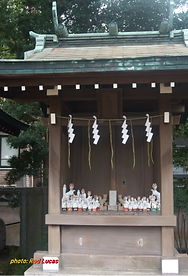
In-ground Subordinate Shrines:
Innai Katori Jinja 院内香取神社
Uba Jinja 姥神社
Hoshi Jinja 星神社
Ishi Jinja 石神社
Inari Jinja 稲荷神社
Kotohira Jinja 金刀比羅宮
Nishinomiya 西之宮
Hachiman Jinja 八幡神社
Hie Jinja 日枝神社
Mitsumine Jinja 三峰神社
Shinmei-Sha 神明社
Ontake Jinja 御嶽神社
Itsukushima Jinja 厳島神社
Mizu-no-Miya 美寿之宮
Annual Festival: August 16-22

Chiba Jinja functioned as a temple for much of its 1,000 year history, and it was not until the enactment of the Distinction between Shinto and Buddhism Order (神仏分離”Shinbutsu Bunri”) in March 1868 that it formally became a shrine. It is often colloquially referred to as Myogen-sama. Myogen(妙見) is a bodhisattva, probably of Chinese origin, considered to be the personification of the North Star (北極星) and the Big Dipper (北斗七星); In the mid-Edo Period the nativist scholar, Hirata Atsutane, propounded a theory contending that Ame-no-Minaka-nushi, the first Japanese Kami, was the primary Kami of the seven major stars making up the Ursa Major constellation, effectively conflating The Buddhist and Shinto deities.
In the late Heian Period, Taira Yoshifumi, the great-great grandson of Emperor Kanmu, and the ruler of much of what is now southeast Kanto, was in the habit of praying to Myogen for success before going off to war, and was invariably successful. Later generations of the Chiba clan descended from Yoshifumi worshipped Myogen as their clan’s guardian deity. During the life of the founder of the Chiba clan, Taira Tadatsune (975-1031), a small shrine (祠, hokora) was built in the grounds of Katori Jinja in what is now Chiba-shi, and Myogen was enshrined using the bunrei process.
The 66th emperor, Ichijo (r. 986-1011) suffered from an eye ailment. He prayed for recovery at the hokora: recovery was immediate and to express his gratitude he bestowed the name Hokutoyama Kongōju Temple (北斗山金剛授寺) on the
hokora. Tadatsune responded by building a real temple on the site and appointing his son, Kakusan, as chief priest, and on Sept 13, 1000 the temple was formally opened. The hokora was subsumed into the temple. The Chiba clan thereafter expanded its power and reach, and by the time of the official second head of the clan, Tsuneshige (常重1083-1180), they had outgrown their traditional power base and moved to what is now Mount Inohana in Chiba-shi, where in 1126 they built a castle of the same name which still exists. Along with this, the shintai of Myogen sama which had been enshrined in the castle where the clan leader had lived was moved to Hokutoyama Kongōju Temple and jointly enshrined with the spirit already there.
1182 saw the first Myogen Grand Festival and it has continued to this day. Its main feature is carrying the sprit of Myogen in a portable shrine to the foot of Mount Inohana.
Among those who visited and supported the temple were Minamoto Yoritomo and Tokugawa Ieyasu, with the latter granting it a special status allowing its representatives to have audiences with the Shogun.
With the the enactment of the Distinction between Shinto and Buddhism Order in March 1868 it had to be decided whether Hokutoyama Kongōju Temple would remain a temple or become a shrine. Following discussions among all relevant parties it was decided that the Myogen Grand Festival outweighed everything else and as this was Shintoist in spirit the temple became a shrine and was named Chiba Jinja.
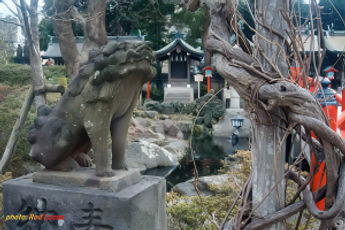
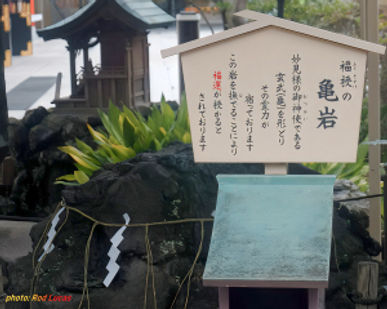
The shrine was basically destroyed in the Great Firebombing of 1945, and the current buildings date to 1990. It was Japan’s first two-tiered jinja and has two halls of worship, one on top of the other. The original shrine hall was rebuilt in 1954, and was later moved to the western part of the shrine grounds. It is now the prayer hall for the subsidiary shrine, Chiba Tenjin. The shrine grounds also contain a sazare ishi.
Click images to expand