Nearest station
Dennenchofū
Tōkyū Tōyoko Line
Tōkyō-to, Ōta-ku, Denenchōfu 5-30-16
東京都大田区田園調布5-30-16
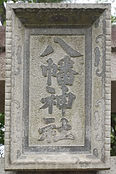
八幡神社
Hachiman Jinja
Home page: (Japanese)
April 25, 2018
Enshrined Kami:
Main
(Note: numbers in parentheses after kami names
refer to position in How Many Kami table)
Hondawake-no-mikoto 誉田別命
From Merged Shrines
None
In-ground Shrines:
Inari-Sha 稲荷社
Annual Festival: October 15
History
The foundation of this shrine is said to be sometime between 1249 and 1256, when the Hōjō clan, was still busy solidifying its power base after having seized the Kamakura bakufu regency in 1203. The shrine is about 600m away from the Tamagawa river and at the time in question there was an inlet called Rōyato (篭谷戸) with favourable currents allowing merchant ships relatively easy access to the area. A small harbour gradually developed and with the main Kamakura Kaidō passing nearby the site was strategically important enough for the bakufu to station many samurai there. Just above the
harbour there was a small plateau and this afforded an excellent vantage point from which to view activity in the harbour. In time a hokora (small shrine) was built there, in a village then called Kamimunabe (上沼部村), and became a Hachiman Jinja through the kanjō process.
In 1590, after the fall of the Hojo Clan, a retainer of Hōjō Ujiteru, the Lord of Hachiōji Castle, Ochiai by name , set up a hermitage near the hokora where he is said to have devoted his time to praying for the prosperity of his clan. In the Kane’i Period (1624-1644) his grandson, Saemon, built a main hall at the hokora and Hachiman Dai Bosatsu quickly became the tutelary deity of Kamimunabe village. In 1792 ownership of the area changed hands but the shrine’s status was unchanged. In 1889 Kamimunabe was merged with three other villages.
Description
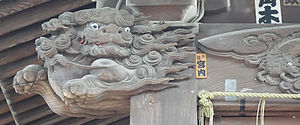
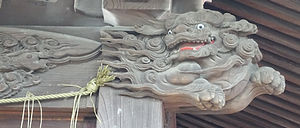
About 1.1 km from Dennenchofū Station. For me the shrine's outstanding feature is the pair of koma-inu in front of the prayer hall. They date to 1921.
(Click on images to expand them)