homepage: none
吉原神社
Tokyo-to, Taito-ku Senzoku 3-20-2
東京都台東区千束3-20-2
April 2, 2026
Nearest station: Iriya Line: Hibiya Subway (H19)


Enshrined Kami:
Kurosuke Inari 九郎助稲荷
Yoshitoku Inari 吉徳稲荷
Enomoto Inari 榎本稲荷
Akashi Inari 明石稲荷
Kaiun Inari 開運稲荷
Yoshiwara Benzaiten 吉原弁財天
In-ground Subordinate Shrines:
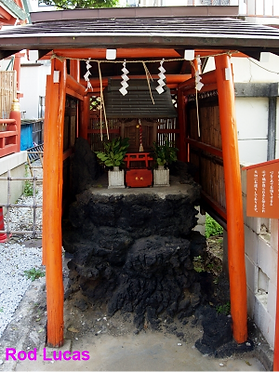
Oaki-sama お穴さま
Annual Festival: 3rd Friday, Saturday and Sunday of May
Although this famous jinja was founded as relatively recently as 1872 its origins date back to the early Edo period. Until 1617 brothels had been scattered around Edo, but in that year the Shogunate granted permission to consolidate all the brothels in one place to a certain Shōji Jin’emon. He seems to have been a merchant who in 1612 set up a brothel in Dosangashi, a docking area near to Edo Castle. There are suggestions that Shōji did this in order to gain the permission he was granted in 1617. The site chosen for the new red-light district, Yoshiwara, was what is now Ningyocho in Nihonbashi: Yoshiwara was originally written as 葦原, meaning ‘weed field’—Ningyocho was at that time overgrown with weeds—but the written name was soon changed to 吉原, 吉 meaning good luck or joy, although the pronunciation remained the same.
The area gradually became the centre of Edo and in 1655 the red-light district was moved to its current location, then known as Ryutenji, the current Senzoku. Its borders were delineated by four jinja placed at each corner, Kaiun Inari Jinja, Enomoto Inari Jinja, Akashi Inari Jinja, and Kurosuke Inari Jinja. One more jinja, Gentoku Inari, stood in front of the Yoshiwara Omon Gate, the sole entrance to the pleasure quarters.In 1881 these five Inari Jina were merged to form the present Yoshikawa Jinja, and just over half a century later the nearby Benzaiten Jinja was also integrated. This latter was a direct result of the Great Kanto Earthquake of September 1, 1923. Like much of Tokyo Yoshiwara was devastated by the earthquake and many of the buildings in the area were burnt down. Desperate to escape the inferno, many people fled to the nearbye Hanazono Park, now known as the Shin-Yoshiwara Park, in which a small pond, Benzen-ike, was located. Even the park offered no respite from the fire and and in desperation many people jumped into the pond : it is estimated that 155 people from the pleasure quarter lost their lives there as did another 490 from normal areas. The shrine was destroyed again in the Great Tokyo Firebombing of March 1945 and was rebuilt in 1968.
Click images to expand