普通の外にいくつかの著名な品質を持っている、と畏敬の念を起こさせるあるいかなるビーイングは、カミと呼ばれています。

Tokyo-to,Shinjuku-ku Shinjuku 5-17-3
東京都新宿区新宿5-17-3
Sept 22, 2026
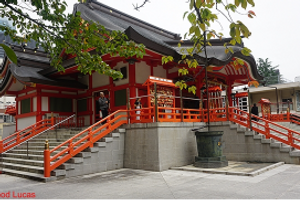
花園神社
Hanazono Jinja
Nearest station: Shinjuku-sanchome Lines: Marunouchi Subway (M09J
Fukutoshin Subway (F13), Toei Shinjuku Subway (S02)
Homepage (Japanese)


Enshrined Kami:
Main
(Note: numbers in parentheses after kami names
refer to position in How Many Kami table)
Uka-no-mitama-Mikoto (75) 稲倉魂命
Yamato Takeru-no-Mikoto 186E 日本武尊
Uke-mochi-no-kami 保食神
In-ground Subordinate Shrines:
Geinosengen Jinja 芸能浅間神社
Itoku Inari Jinja 威徳稲荷神社
Osame Daimyojin 納大明神
External Subordinate Shrines:
Raiden Inari Jinja 雷電稲荷神社
(Shinjuku 4-4-23)
Annual Festival:
Nearest Saturday to May 23


Although we do not know when this jinja was founded it is thought to have been in existence in 1590, the year in which the Tokugawa clan entered Musashi Province; by the time the Tokugawa Shogunate was established in 1603 it was regarded as the main tutelary kami for Shinjuku.
Until 1644 the shrine was located some 250 metres to the south of its current location near what is now the Isetan Department Store. However, a direct retainer of the Shogunate was allowed to build a secondary residence on that plot of land. Parishioners and others were very unhappy that their shrine was now on private property, making access to it uncertain, and petitioned the Shogunate that the shrine be moved to a more appropriate place. The petition was accepted and the shrine was moved to
what is now its current location in what was then the garden-cum-park of a senior Tokugawa family. The abundance of flowers there resulted in the shrine becoming known as Hanazono , lit “Flower Park”, Inari Jinja.
The first historical mention of the name Hanazono Jinja was in 1803. The shrine had been destroyed by fire and a plaque donated by a town council expressing hopes that the shrine would be rebuilt bore the name “Hanazono-sha,” However, it would be over a century later before the shrine would be officially named Hanazono. During the Edo Period it was known both as Inari Jinja and Sankoin Inari, and occasionally as Yotsuya Oiwake Inari (there are two other Oiwake Inari Jinja in Shinjuku, both very interesting)
The Sankoin Inari Jinja name comes from the fact that the Sankoin-Temple was the shrine’s betto-ji during the days Shinbutsu Shugo, when Shinto and Buddhism coexisted peacefully. With the advent of the Meiji Period and the separation of Shinto and Buddhism, Shinbutsu Bunri, the Sankoin Temple was essentially shut down.Due to a bookkeeping glitch it was not until 1916 that the name Hanazono Inari Jinja was adopted. Another near half-century passed before the shrine was finally named Hanazono Jinja. This was in 1965, when the shrine buildings were reconstructed, and Otori Jinja, which had been a subordinate shrine, was merged into the main shrine.
click images to expand
Click images to expand